laser pict

laser pict
Showing posts with label hairreduction. Show all posts

22 April, 2017

Laser Mechanism and The Benefits


Hi guys,
Welcome back to the second post of my blog, I finally can blog again in between my assignments. So this post will be covering a little bit in depth about the Laser and IPL settings such as the wavelength, pulse duration, fluence, frequency and etc. Not only that, it will discuss about the pros and cons of laser and IPL, Fitzpatrick skin types, types of lasers and how to know which modality is suitable for you. Therefore, please bear with me for some minutes or you can just skip till the end if you already know about the laser terms.

What is Light?
It is an electromagnetic radiation within a certain portion of the electromagnetic spectrum. The amount of energy that is carried by each photon can be determined by the wavelength of the light. Some research shown that the light is exist in two ways which are the particles (light moves as a stream of photon particles; each particle represent a single quantum of light) and waves (a disturbance or oscillation that travels through either matter or space resulting in a transfer of energy).


Laser Terminology:

·         Wavelength (λ) is the length of a complete wave cycle measured from crest to crest or trough to trough. The standard international (SI) unit is in meter (m). The energy of photon can be described by the wavelength: the shorter the wavelength, the higher the energy and the longer the wavelength, the lower the energy of photon.

·         Amplitude (A) is the amount of displacement of a particle from its position of rest. It measure from the distance from the resting position (center line of the wave) to the tip of the crest or trough. The SI is in meter (m). The energy of photon can be described by the amplitude: the higher the amplitude, the greater energy and the lower the amplitude, the lower the energy.

·         Pulse duration is the length of time laser beam is being delivered or the exposure duration per pulse that usually measured in second, millisecond or nanosecond. Sub-pulses are some pulses with the equal total energy in the same length of time.

·         Frequency is the energy delivered to the tissue unit area. It can be measured in second (s) or Hertz (Hz) represent 1 wave per second. Fluence is the pulse energy in the treated area, often measured in J/Cm2. The shorter wavelength has a high frequency and the longer wavelength has a lower frequency.

·         Spot Size is the size of the laser pointer and it can alter the depth of the focal point reached within the skin and the level of light scattering when performing the treatment. It usually measured in mm and used depend on size of the treatment area.


How does stimulated emission work in laser?

The laser utilise stimulated emission to create light by stimulating the electrons to its excited state within the laser medium. It is called population inversion which means that the electrons are moving from the ground energy state to the higher energy state forming a photon. This process is achieved by adding electric energy into the laser medium resulting in the spontaneous emission (the unstable state of electrons). Then, there are millions of photons released into the laser cavity via the spontaneous emission and traveling into random directions.
Fortunately, there is only one photon travels in the right direction initiating the stimulated emission (the ground state of electron). Then it released the photons and allows atom to emit light and hence the laser beam is produced. The produced laser beam then going through a process called amplifications. It is to ensure that there is enough photons to be emitted to produce laser beam by amplify the photons. By using mirror, the photons are being amplified in the laser cavity and reflects the newly photons back into the same directions and collide into each other creating stimulated emission. After going through this process, the laser beam is produced to create energy.


Is laser for hair reduction ionising or non-ionising?

It is non-ionising, which mean it safer and not enough to cause chemical changes by breaking the chemical bonds of the tissue.


What is electromagnetic spectrum?
It includes radio waves, microwaves, infrared rays, light rays, ultra violet rays, X‑rays and gamma rays. It is transmitted through empty space at 3.0 X 10⁸ m/s (300 thousand kilometres per second). There are two ways to distinguish the forms of electromagnetic spectrum: from their wavelength and form the amount of energy transfer. The longer the wavelength the non-ionising it is and the higher the energy is the more ionizing.

What is Fitzpatrick Skin Phototype Classification (FSPC)?
It is a tool to assess his patient’s sensitivity response to phototoxic reactions during their phototherapy treatments. It is made up of 4 elements; Fitzpatrick, Hyperpigmention, Glogau and Scarring.


What are the types of laser available and what are the pros and cons?


·         Ruby laser 694nm

(+)   For Fitzpatrick I & II

         Shorter wavelength therefore superficial penetration

        Suitable for dark hair with lighter skin

(-)    Darker Fitzpatrick III – VI

Not usually used as it can cause post hypopigmentation in Fitzpatrick II


·         Alexandrite Laser 755nm

(+)   For Fitzpatrick I – III

          More painless than the other lasers

        Good results and minimal side effects

        Cost effective

(-)    Darker Fitzpatrick IV - VI


·         Diode Laser 800-8100nm

(+)   For Fitzpatrick I - III

(-)    Darker Fitzpatrick IV – VI


·         Nd:YAG (Neodymium: yttrium aluminium garnet) Laser 1064nm

(+)   Darker Fitzpatrick III – VI

         Longer wavelength or penetration

        Suitable for dark and coarse hair

(-)    Lighter Fitzpatrick I & II


·         Intense Pulsed Light (IPL) 400-1200nm

(+)   Lighter Fitzpatrick I – III

         Lower cost

        Larger spot size therefore minimal treatment time

Have many filters, so it can be modify to suit specific skin and hair types

        Can be used to treat vascular lesion

(-)    Darker Fitzpatrick IV - VI


References:


Ahluwalia, G. (2009). Cosmetic Applications of Laser and Light Based Systems. Burlington: Elselvier

AS/NZS4173:2004 Guide to the Safe Use of Lasers in Health Care

Alqubaissy, Y, Mcleod, MP & Nouri, K 2011, ‘Laser hair Removal Pearls in Skin of Color’, Journal of Drugs in Dermatology, vol. 10, no.12, pp. 12-13.

Babilas, Philipp., Schreml, S., Szeimies, R-M., & L, M. (2010). Intense pulsed light (IPL): a review. Lasers in Surgery and Medicine,42, 93-104

Csele, M. (2004). Fundamentals of Light Sources and Lasers. Hoboken: Wiley

Goldberg, DJ 2007, ‘Laser-and light-based hair removal: an update’, Future Drugs Ltd, no. 1743-4440, no. 10, pp. 253-260.

Hruza, G.J., & Avram, M.M. (2012). Lasers and Lights. Philadelphia: Saunders

Hooker, S & Webb, C 2010, Laser Physics, Oxford University Press, New York, United States.

Ibrahimi, O, A., Avram, M, M., Hankes, C, W., Kilmer, S, L., & Anderson, R, R. (2011). Laser hair removal. Dermatologic therapy, Vol 24, 94 - 107

Kitsinelis, SP. (2011). Light Sources Technologies & Applications. Boca Raton: Taylor & Francis

Lipson, SG, Lipson, H, Tannhauser, DS 1995, Optical Physics, 3rd edn, Cambridge University Press,Cambridge, Great Britain

Ravnbak, M, H. (2008). Objective determination of Fitzpatrick skin type. Danish Medical Bulletin, pg 1 -6

Tay, Y.K., & Chan, Y.C. (2011). Textbook of Laser and Light Dermatology in the Asian Skin. New Jersey: World Scientific

Wassserman, DI & Chuang GS 2011, ‘Update on cutaneous laser therapy: recent medical advances of laser light and skin interactions’, Cosmetic dermatology review, vol. 6, no.2, pp. 163-174
Watanabe, S. (2008). Basics of laser application to dermatology. Arch Dermatol Res S21 – S30


28 February, 2017

Getting to know "LASER"

Hi guys,
          As I said in the "About the Writer" section on the right side, I will make this blog specifically discussing about laser hair removal, types of laser with their pros and cons, how it works, contraindications, your hair growth cycle, and the possible side effects that can be caused if the treatment goes wrong.
        Being around in the laser industry, I know this treatment is getting more popular as it is less painful than waxing. As it is more popular and in demand, many clinics are trying to offer laser hair removal treatment. However, some of them didn't realise the side effects that can be caused by this machine and sometimes some clinics just hire their employee that doesn't have a proper knowledge about how to use laser or even just giving them a brief "How to use this laser" lecture to their employee. Therefore as a Dermal clinician, I thought that I need to give you guys a good knowledge about laser hair treatment before you commencing into one. It can also open your mind, giving you confident, and of course, saving you from getting any unwanted end results. 
           
Okay, just let me get it straight into the business. I'm gonna do it as a Q&A to make it simple:

What is Laser ?
Most of you probably didn't know what Laser is actually, it is an abbreviation from Light Amplification by Stimulated Emission of Radiation. 

How does it works ?It is going to treat hairs using light, based on selective Photothermolysis concept (it is a concept on how the laser light will choose to be absorbed by the target melanin that lies in the hair follicles so that the skin will not get burn) to target the hair follicles and causing thermal damage (heat damage). The thermal damage will cause permanent damage to the hair follicle and resulted in delay of growth until it is incapable of producing any hair. So it needs several treatments until the hair won't grow back and it is depends on your hair because everyone is different.

Why we need several treatments to get it done ?
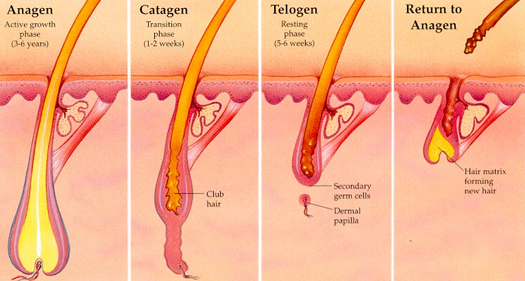
It is because we have 3 different hair stages (Anagen, Catagen, and Telogen).


The hair stage that should be targeted is the anagen stage (growing stage) as it undergoes mitotic activity (still growing and seperating) and contains huge amounts of growth cells and melanin (colour pigment of the hair). It specifically targets the melanin of the hair that is located in the root sheath of the hair follicles without damaging the surrounding tissues. Also our hair had the 3 stages at the same time. so we need to get several treatments to ensure that all of the anagen hair are treated until it won't produce any hair.

Is laser the same with IPL ?
NO, it is different. IPL is a device that using a high intensity pulsed light to help reducing unwanted hair, vascular and pigmented lesions, and photo-rejuvenation which emitting broad wavelength with polychromatic (have many colours) light (400-1200 nm). It used selective filters to determine the wavelength, pulse duration, and fluence by emitting polychromatic incoherent pulsed light.

Which one is more effective, IPL or Laser?
It is depends on your hair types and your skin colour as both machine have different wavelengths and pulse duration. 

Is the treatment gonna be painful?
No, you might feel like a rubber band flicking into your skin and you might experienced some heating and some redness in the area but pretty much nothing. As the machine had their cooling machine installed it will reduce the discomfort during the treatment.

Are there any potential damage that can be cause by the laser?
Hyperpigmenation
  • Mostly burns, if the laser settings is not compatible with your skin colour and your hair type it can cause burns.
  • Some post-hyper or hypo pigmentation.  
  • Photosensitising medications such as retinoid and blood thining medication can be one of the cause. 
  • Uveitis & iristis if the laser was accidentally directed to unprotected eyes. Bad laser technique can be fatal as it can accidentally shoot the laser into other direction therefore protective googles must be used during treatment, it can also caused burn into the area that not being treated.
  • Blisters may present after the burn if it not treated carefully and leads to infections
  • Paradoxical Hypertrichosis: it is rarely happens and only happens to people that have a hereditary in this condition as the laser can trigger the sudden hair growth as seen in Wolfman syndrome.
  • Micro crusting  (the darkening of the skin) may also occur.
  • Contact dermatitis and other skin infections can occur if the laser point is not properly cleaned.
  • Leukotrichia: white patches that caused by high energy laser pulsed that kills the skin pigments and makes it white.

Are there any precautions and contraindications regarding to the treatment?
Contraindications:
  • Epilepsy
  • Lupus
  • Cancer
  • Pregnancy or planning to get pregnant as it can change the hormones and the hair might comeback after the treatment (waste of money and time), and it is also quite dangerous for the baby. So, if you want to have this treatment you can have it after you finished breast feeding your child.
  • Keloid scarring
  • Blood disorder
  • Medications that induced photosensitivity eg. isotretinoin and minocycline, doxycycline. or any vitamins that contains vitamin A. The treatment may be considered if there is no usage 3 months post treatment and during the treatment.
  • Vitiligo as it can worsen or trigger the formation in the other area of the body
  • Pigmented naevi as it can progress into cancer
  • Benign melanocytic lesions
  • Pace maker
  • Coronary and blood pressure conditions
  • Hormonal condition
  • Thyroid gland as it is sensitive to light
  • Diabetes as it had reduced healing capacity and has sensory neuropathy (loss of ability to detect sensation)
  • Grey hair, as it will not be effective but other treatment like electrolysis can be used
  • Keloid and Hypertrophic scars it is an abnormal wound healing responses
Precautions:
  • Allergy to the product used eg. aloe vera or coupling gel
  • Sunburn
  • Sun tanned skin
  • Artificial tan
  • Recent sunburn, tanned and artificial tan can misguided the laser light from being absorbed by the skin so it is best to remove artificial tan and wait for recent sun burnt to heal (approx. 2-4 weeks) before commencing the treatment.
  • Gold therapy as it contains metal that can cause reaction with the light interaction
  • Tattoos, be aware of having treatment in the area that have tattoos as it can absorb the light energy and caused skin burn.
  • Oral contraceptives as it can changes the skin pigmentary so it is best to not using this 3 months before and during the treatment to get a better result
  • Infections and injury in the area treated
  • Open cuts on the area treated
  • Clients with unrealistic expectations as there is a different between permanent hair reduction and complete hair removal, so there will not be a complete hair removal as laser can't treat grey and blonde hair but having an electrolysis after having laser can help treating the untreated hair from the laser treatment.

Is there anything to do before going for the treatment?
The reception may ask you to shave 1 day prior to treatment as we can accidentally give you some cuts if we have to shave you and avoiding open cuts. Not using artificial tan or just have a tan or sun burnt, not pregnant or planning to be pregnant (see contraindications). Not having allergies, not in certain medications, don’t have any metal implants on the body, not having any contraindications.

What is going to happens then?
You will be given a consultation session, a brief education about the laser and IPL, and then discussing the price, then you will be given a patch test just to make sure everything okay. But nowadays many clinics doesn’t give you patch test before commencing the treatment, so make sure you ask for one. Then you will discuss for the following treatment usually a week after.

What is a patch test?
Patch test is a test on a small area that can be a representative of the bigger area that wants to be treated that can be a parameter guide. It is important because it can reduce the risks of adverse reactions, and improves treatment efficacy.

What is the Post care after having a laser treatment?
The therapist may advise you to put on some cooling gel or aloe-vera to reduce the redness and the heat. There will be no sauna, no workout, no swimming for 24 after the treatment and always use sunblock on the treatment area.

What are the desired reactions after the treatment?
Some redness (Perifollicular Erythema), some chicken skin texture like (Peri follicular Oedema), warmth, and transient oedema (little bit swelling). But it will disappearing after 24 hours, so don’t worry about it as it signifies that the treatment is working.

Is there anything else regarding to the treatment?
Yes, just keep in mind to keep your eyes protected and closed during the treatment, don’t look directly to the laser, make sure the therapist clean the laser before the treatment and using gloves to prevent cross contamination and using disposable and hygienic tools.

So, basically this is just the basic things that you have to do before you commencing a laser treatment. Oh, and as a dermal therapist, please.. please.. please .. don't bring your child into the laser treatment room with you as it is dangerous, as the children may touching something during the treatment. So, as the representation of the dermal therapy out there. I beg you to not letting or insisting your child inside the laser room during the treatment.
I know it is already too much to be processed, lots of information, but I will post about the types or laser, how it really works, the pros and cons, and how to choose the perfect laser treatment for you. I will post it as fast as I can do, so make sure to follow my blog to keep update. Just to make it short, if you have a question regarding the laser or the laser treatment please feel free to comment below as I will get it back to you ASAP. Thank you for reading this post, may this post be able to give you some knowledge or maybe helping you to work on your laser essay. 

 Reference lists:

Babilas, P., Schreml, S., Szeimies, R., & Landthaler, M. (2010). Intense pulsed light (IPL): A review. Lasers in Surgery and Medicine, 42(2), 93-104. http://dx.doi.org/10.1002/lsm.20877
Casey, A., & Goldberg, D. (2008). Guidelines for laser hair removal. Journal of Cosmetic and Laser Therapy, 10(1), 24-33. http://dx.doi.org/10.1080/14764170701817049
Chen, J., Liu, X., & Huo, M. (2012). Split-leg comparison of low fluence diode laser and high fluence intense pulsed light in permanent hair reduction in skin types III to IV. Australasian Journal of Dermatology, 53(3), 186-189. http://dx.doi.org/10.1111/j.1440-0960.2012.00879.x
Dereure, O. (2001). Drug induced skin pigmentation: epidemiology, diagnosis and treatment. American Journal of Clinical Dermatology, 2 (4), 253-262.
Eadie, E., Miller, P., Goodman, T., & Moseley, H. (2007). Time resolved measurement shows a spectral distribution shift in an intense pulsed light system. Lasers in Medical Science, 24(1), 35-43. http://dx.doi.org/10.1007/s10103-007-0517-z
        Goldberg, DJ 2008, Laser Hair Removal, 2nd Edition Informa healthcare, New York, USA.
Goldberg, DJ. (2007).Laser-and light-based hair removal: an update. Future Drugs Ltd, no.1743-4440, no. 10, pp. 253-260.
Harris, K., Ferguson, J., & Hills, S. (2012). A comparative study of hair removal at an NHS hospital: luminette intense pulsed light versus electrolysis. Journal of Dermatological Treatment, 25(2), 169-173.
Lanigan SW (2003) Incidence of side effects after laser hair removal. Journal of American Academy of Dermatology 49(5):882–886.
Lapidoth, M., Shafirstein, G., Amitai, D, B., Hodak, E., Waner, M & David, M. (2004). Reticulate
erythema following diode laser assisted hair removal: a new side effect of a common procedure. Journal of American Academy of Dermatology, Vol 51, Number 5, pg 774-755.
Radmanesh M, Mostaghimi M, Yousefi I, Mousavi A B, Rasai S, Esmaili H R, Khadivi H A., (2002). Leukotrichia developed following application of intense pulsed light for hair removal. American Society for Dermatologic Surgery, Inc 28:572-574
Randall, VA, Lanigan, S, Hamzavi, I, & Chamberlain James, L. (2006). New Dimensions in Hirsutism’, Lasers Med Sci, vol. 21, pp. 126-133.
Shllhayer K., (2007) Mechanisms of laser hair removal: Could persistent photoepilation induce vitiligo or defects in would repair. Dermatol Surg 33:1055-1065
Thaysen-Petersen, D., Bjerring, P., Dierickx, C., Nash, J., Town, G., & Haedersdal, M. (2011). A systematic review of light based home use devices for hair removal and considerations on human safety. Journal of the European Academy of Dermatology and Venereology, 26(5), 545-553. http://dx.doi.org/10.1111/j.1468-3083.2011.04353.x